Forgetfulness or Dementia? When to Be Concerned
Wondering whether forgetfulness is normal aging or an early sign of dementia? This gentle guide explains the key differences, common warning signs, when to see a doctor, and simple ways to feel more secure
UNDERSTANDING DEMENTIA
Forgetfulness or Dementia? When to Be Concerned
Post 5
🌿 When Small Uncertainties Appear
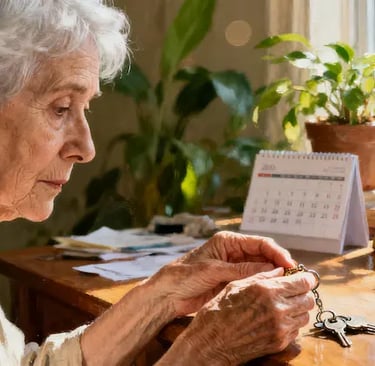
You've misplaced your keys again. A name you know well won't come. You stand in the supermarket and can't quite remember what you came for.
And then the question arrives, quietly: is this still normal?
It's a question many people carry sometimes about themselves, sometimes about someone they love. And it deserves a honest answer, not a dismissive one.
The short version is this: not every memory lapse is a warning sign. Normal forgetfulness and early dementia can look similar on the surface, but they feel and function quite differently. Understanding the difference can bring clarity and clarity, in this particular uncertainty, is worth a great deal.
🌲 What Normal Forgetfulness Looks Like
Forgetting things is part of being human. Stress, poor sleep, distraction, doing too many things at once all of these affect memory, and all of them are completely normal. Research consistently shows that occasional lapses in memory are experienced by almost everyone and do not indicate any underlying condition.
The kinds of forgetfulness that fall within normal range include misplacing keys or glasses and finding them later, not immediately recalling a familiar name but remembering it after a moment, forgetting what you did last Tuesday but being able to piece it together when you think about it, walking into a room and briefly losing track of why, or a word sitting on the tip of your tongue that won't quite come.
What these moments have in common is that they are occasional rather than constant, they don't stop you from functioning, and with a little prompting or time, the memory usually returns. After the age of 50 it is also normal for memory retrieval to slow slightly this is not decline, it is simply how the brain ages.
🌼 When Forgetfulness Becomes a Pattern
The shift worth paying attention to is not a single forgotten name or a misplaced phone. It is when forgetfulness becomes more frequent, more disruptive, and starts to affect daily life in ways that didn't happen before.
Some signs that warrant attention: bills being repeatedly forgotten or paid twice, important appointments missed consistently rather than occasionally, recent conversations or visits seeming to leave no trace at all, getting lost or disoriented in familiar surroundings, familiar tasks like cooking a known recipe or using a familiar device becoming genuinely difficult, or language starting to slip finding words increasingly hard, using descriptions in place of names, struggling to follow a conversation.
One pattern worth noting is that early dementia tends to affect recent memory more than older memory. Someone may forget what happened this morning but recall in vivid detail something from forty years ago. This is not selective it reflects how the condition affects the brain's ability to form and store new information while leaving older memories relatively intact.
None of these signs on their own confirm dementia. Doctors never diagnose based on a single lapse or even a difficult week. They look for patterns that develop over weeks and months, and they rule out other causes first because a number of entirely treatable conditions can produce similar symptoms, including vitamin B12 deficiency, thyroid problems, depression, and certain medication side effects.
🌿 When to Seek Medical Advice
If forgetfulness has been increasing over several weeks or months, if daily life is being affected in ways that feel new, if familiar things are becoming consistently difficult, or if someone close to you has noticed changes it is worth speaking to a doctor. Family members and close friends often notice shifts before the person themselves does, and that observation matters.
Early assessment is worth seeking not because a diagnosis is inevitable, but because clarity helps. Many causes of memory changes are fully treatable. And if dementia is diagnosed, earlier support means better access to care, therapies, and planning.
🌲 Preparing for a Doctor's Appointment
Going to a doctor with memory concerns can feel daunting. A little preparation makes the conversation more useful for everyone.
In the weeks before the appointment, it helps to keep a simple diary of specific examples not vague impressions, but concrete moments. The date, what happened, how often it has occurred, and whether it affected daily life. Three or four weeks of this gives a doctor something real to work with rather than a general sense that something feels off.
Bring a full list of all medications, including over-the-counter ones and supplements, with dosages and how long they have been taken. Some medications affect memory in ways that are easily overlooked, and a doctor needs the full picture.
If possible, bring someone you trust. They can add observations you might not think to mention, help you remember what the doctor says, and offer support in what can be an emotionally charged conversation.
It is also worth thinking in advance about what you most want to know. Questions worth asking include what tests are needed and how long the process takes, whether other conditions could explain the symptoms, what treatment or support options exist, and what to expect in the weeks ahead.
A diagnosis or the absence of one rarely comes in a single appointment. The process typically includes short memory and orientation tests, a physical examination, blood tests to rule out treatable causes, and sometimes imaging. It unfolds over time, and that is appropriate. Memory is not something to be rushed to conclusions about.
🌼 If a Second Opinion Feels Right
If the diagnosis is unclear, if the symptoms are unusual, or if something about the assessment doesn't feel complete asking for a second opinion is entirely reasonable. This is especially true for less common forms of dementia, for early-onset presentations, or before making significant decisions about care or treatment. A good doctor will not be troubled by this request.
🌿 Gentle Support in the Meantime
Whether or not there is a diagnosis, simple daily structures can make memory feel more manageable. Consistent routines, visible notes and reminders, keeping important items in the same place, good sleep, and regular gentle movement all support cognitive function in ways that are well evidenced.
Familiar activities, sorting, gentle creative tasks, music from earlier years can also provide a sense of calm and competence on harder days. More on these in Posts 1 through 4.
🌱 A Closing Thought
Worrying about memory, your own or someone else's, is one of those quiet anxieties that can sit with a person for a long time before they say it out loud. If this post has given you a little more clarity about what is worth noticing and what is worth setting aside, that is enough.
If something feels persistent and out of the ordinary, trust that instinct and seek advice. You are not overreacting. You are paying attention and that is exactly the right thing to do. You are not alone. Support and guidance for caregivers are available in Post #7: Understanding Dementia: Gentle Orientation for Family Members
🔗 Further reading:
Frontiers: Vitamin B12 and cognition
🔗 Forward/Back Navigation
👉 Next: Post #6 – Understanding Dementia: Causes, Symptoms, and Types Explained Simply
👈 Back: Post #4 – Creative Activities in Dementia