Creative Activities in Dementia | Small Moments of Connection
Gentle creative activities for people living with dementia. Simple ideas that awaken memories, support calm, and create moments of closeness and dignity.
CREATIVE ACTIVITIES
Creative Activities in Dementia Care: 5 Simple Ideas for Everyday Life
Post 4
🌿 When Hands Have Something to Do
Many family caregivers are looking for something that helps without overwhelming. Something that creates closeness even when conversation becomes harder. Something that makes the day a little lighter for the person with dementia, and for themselves.
Creative activities can be exactly that. Not because they train or rehabilitate, but because they give hands something familiar to do. And because in that quiet doing, moments sometimes arise that you didn't plan and won't forget.
The five ideas here need no preparation, no specialist knowledge, and no budget. They need a little time and a willingness to sit alongside someone.
🌲 Why Making Things Works So Deeply
While names and facts fade, the body's memory often stays surprisingly intact. Movements repeated hundreds of times: sorting, folding, colouring, they sit deep. They don't need explaining. The hands still know what to do.
That creates something important: the feeling of still being able to do something. Still being present. Still mattering.
As we saw in Post 2, restless hands are often looking for a task. Creative activities give them exactly that without pressure, without expectation.
🌼 Five Ideas That Have Worked
1. Sorting Colours
I used to collect coloured milk bottle lids, all shades, all sizes, gathered over months, some where donated. Once I had enough, I'd scatter them across the table and simply watch what happened. He would sit there and sort them, quietly and methodically, for longer than I expected. A few weeks later there were several people gathered around the same table, all sorting together, without anyone suggesting it.
Later I tried the same thing with coloured casino chips. They work beautifully satisfying to hold, easy to group, simple to repeat. Red with red, blue with blue. No instructions needed.
The milk bottle lids had a second life too. We used them for bingo, same lids, completely different energy. It's worth holding onto versatile materials like that.
2. Sorting Buttons
One day I brought in a big bucket of buttons, no particular plan, just curiosity. I set out three ice cream containers: one for small buttons, one for medium and one for large. Then I sat down and started sorting myself.
It caught on immediately. People reached in, felt the buttons between their fingers, compared sizes, made decisions. Some worked quietly and methodically. Others held a button up to the light and remembered where they'd seen one like it before. The sorting gave their hands direction, but the buttons gave them something more, a texture, a memory, a small moment of recognition.
A bucket of buttons and three containers. Sometimes that really is enough.
3. Colouring In
There are free colouring pages online, simple ones print well and work perfectly. But often I just drew something myself: a big star, a tree with or without a sun. Thick lines, large areas, no fiddly details. That's all it takes.
With colouring there is no right and no wrong. Colours can be chosen freely. If someone colours a tree blue, it's a blue tree and it's exactly right. The goal was never the finished picture, it was the quiet, focused minutes of making it.
4. Collages
I have to be honest here: it didn't work when I tried it. I brought the magazines, set out the scissors and glue, sat down with a group and nothing quite clicked. The energy wasn't there, or I wasn't doing something right. I'm still not entirely sure which.
A colleague of mine had real success with collages. The same residents, similar materials but when she ran it, something happened. People engaged, chose images, arranged things with care. I watched her do it once and still couldn't put my finger on what made the difference. Maybe her particular patience with it or maybe the way she started.
What I took from that: not every idea suits every person, and not every approach suits every carer. That's not failure. It's just how it works. But because it worked for her, it may well work for you and it's worth trying.
5. Music
Music was almost always reliable, especially in a group.
What surprised me most was Tchaikovsky. I wouldn't have predicted it, but most people responded, settling into it, becoming still and attentive in a way that didn't happen with everything. Someone closed their eyes. Someone else began to sway without seeming to notice they were doing it.
Others wanted something closer to home. YouTube became invaluable for finding songs from the 1940s and 50s, the ones people had grown up with, danced to, heard on the radio in their kitchens. The response was often immediate.
And then there was one moment I think about often. A resident who was non-verbal, who rarely showed much reaction to anything, began swaying gently when "You Are My Sunshine" came on. Just that. a quiet, private sway. But it was unmistakably there.
Music doesn't need an activity built around it. It can simply play. The person decides whether and how they respond.
🌿 What I've Learned About All of This
None of these ideas work every time. Some days nothing lands. Some people simply don't want to and that's entirely their right.
But when it does work, it's usually because the activity is familiar, because there's no pressure attached to it, and because someone is simply present alongside them. Not directing, not correcting just there.
That presence is often worth more than the activity itself.
🌼 When Starting Feels Hard
Many caregivers wonder: am I doing this right? Is it too simple? Is it enough? Yes. It is enough.
Put the materials where they can be seen. Sit down nearby. Start doing something with them yourself. Curiosity often follows without any invitation, without any explanation.
And if it doesn't that's alright too. Tomorrow is another day.
🌱 A Quiet Closing Thought
Coloured milk bottle lids scattered on a table. A hand reaching into a bucket of buttons. A non-verbal resident swaying to a song she hadn't heard in decades.
Small things. But they leave something behind in the moment itself, and sometimes long after.
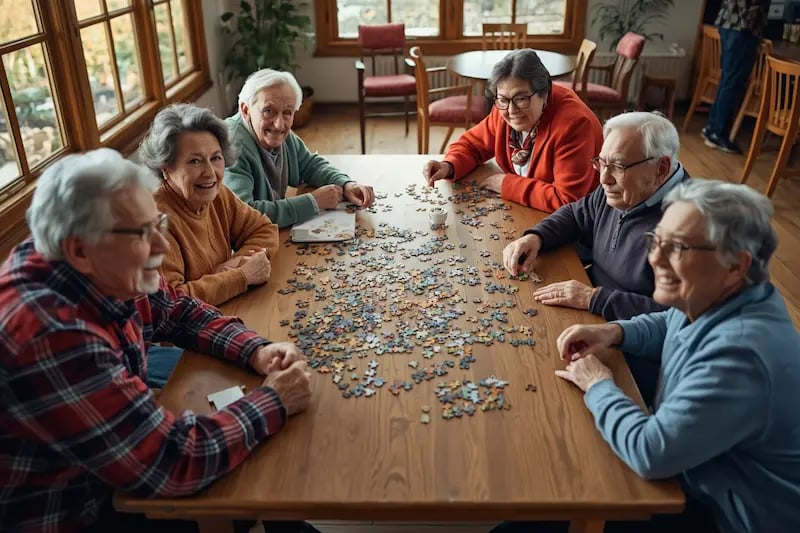
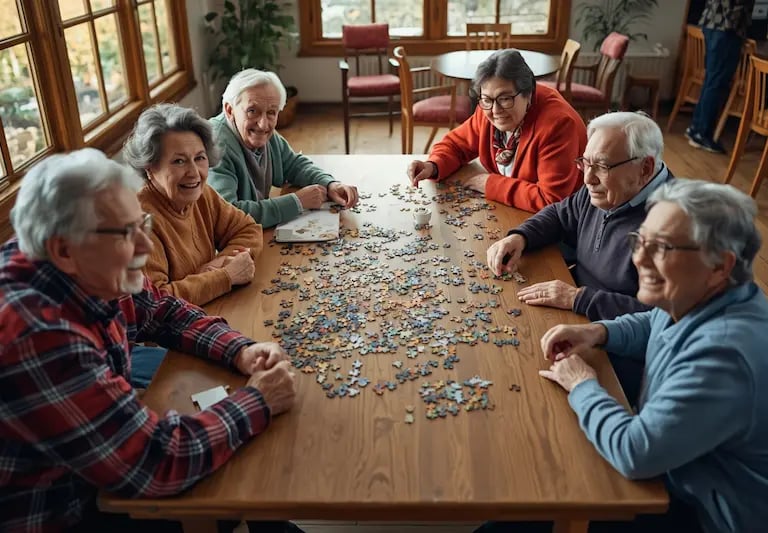
A small bonus: Simple puzzles can also be helpful. They support concentration, offer small successes, and provide that reassuring “I can do this.” Even a few minutes can be enough to experience familiarity, calm, and joy.
🔗 Forward/Back Navigation
👉 Next: Post 5 – Forgetfulness or Dementia? Normal Memory Lapses vs Warning Signs
👈 Back: Post 3 – Movement in Dementia – When the Body Remembers