Why Familiarity Helps in Dementia: Music, Memory Boxes & Calming Routines for Caregivers
Discover why familiarity matters in dementia: familiar music, scents, memory boxes, and simple routines create safety, calm, and connection for your loved one. Gentle caregiver ideas backed by everyday examples and research.
VERTRAUTHEIT & ERINNERUNGEVERYDAY LIFE & FAMILY CAREGIVERS
Why Familiarity Matters So Much in Dementia
Post 1
🌿 When Familiar Things Open Doors
There are days when it feels like you can no longer reach the person you're caring for. What worked last week doesn't work today. The conversation goes nowhere. The restlessness won't settle.
This is not your fault.
People living with dementia often need something different from what we think to offer. Not new activities or more stimulation but familiar things. Small anchors from a life they still carry somewhere inside them.
When short-term memory fades, older memories often stay surprisingly clear. A scent, a song, a well-worn object, a phrase they said a thousand times these can open doors that nothing else reaches. They offer something that is often missing: a sense of knowing where you are.
🌲 Why the Old Things Still Work
It sounds simple, but there is real research behind it. Familiar stimuli, known sounds, routines, objects from earlier life, can ease agitation and support a sense of calm in ways that new activities often cannot.
Long-term emotional memory tends to outlast factual memory. So even when someone cannot tell you what year it is, they may still light up at the smell of coffee in the morning, or the opening bars of a song they danced to decades ago.
Familiarity works not because it reminds people of the past, but because it gives the present moment a feeling of recognition. And recognition, however brief, is steadying.
🌼 What I've Seen Myself
I worked in a group setting for a while, and one afternoon stays with me.
We were sitting together quietly, a mix of residents, some more present than others. I started reciting the beginning of a poem. "Hickory dickory dock, the mouse ran up the..." and left it open. One resident finished it without hesitation as if the words had been waiting there all along.
Another resident responded differently. I tried a different approach, familiar sayings. "Red sky in the morning..." and again, left it hanging. She smiled and completed it.
None of them needed to be taught anything. The familiarity did the work.
🌿 Ideas for Familiar, Comforting Moments
These are not therapy sessions or activities to schedule. They are small invitations.
Music from earlier years. A familiar song can say more than many words. Sometimes just having it playing quietly in the background is enough. You don't need to sing along or make it into something. Let it land however it wants to.
Sayings and familiar phrases. Well-known expressions, proverbs, nursery rhymes, old songs can invite participation in a way that open-ended conversation sometimes can't. They offer a shape the person already knows, which makes joining in feel natural rather than demanding.
Scents that unlock memories. Coffee, soap, baked bread, a familiar perfume. Scents are often the strongest bridge to older memories. Used gently, they can shift the atmosphere of a whole morning. A small note: essential oils can carry risks if used without guidance, so it's worth seeking advice before using them regularly.
Hands-on familiar tasks. Folding, sorting, arranging, simple repeated movements that the body still knows. More on this in Post 2 From Restlessness to Calm: Meaningful Hand Activities for Dementia Care and Post 3 Movement in Dementia – When the Body Remembers, but even here, the principle is the same: familiarity does the work.
📦 A Memory Box - Familiarity You Can Touch
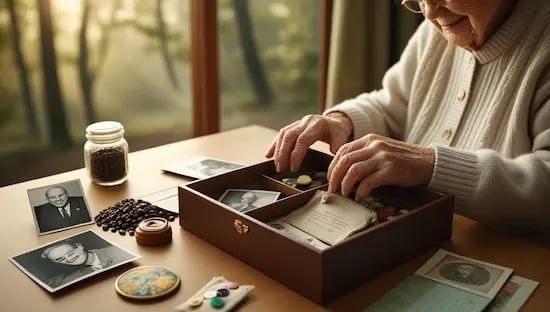
A memory box is one of the most practical things a family caregiver can put together. It doesn't need to be elaborate, a sturdy box with five to ten objects that connect to the person's life is enough.
Things that tend to work well: photographs from different stages of life, a piece of familiar fabric, a small object from a former job or hobby, a postcard, something with a scent attached to a memory. The point is not to test memory - avoid asking "do you remember this?" simply open the box together and let things unfold at their own pace.
It's particularly useful during difficult transitions: before an appointment, during a moment of distress, or on days when nothing else seems to help. Having something familiar and physical to hold can settle things when words cannot.
🌿 Seasonal Rhythms
Seasons carry their own familiar weight. Autumn smells, winter lights, the sound of birds in spring, these rhythms are deeply anchored in long-term memory and often remain when much else has faded.
You don't need to create elaborate seasonal activities. A few autumn leaves on the table, a familiar winter song, the smell of something warm in the kitchen, these small gestures connect to a lifetime of the same season, year after year.
🌱 A Closing Thought
Familiarity doesn't fix anything. It doesn't stop the progression of dementia or solve the hard days.
But it can change the tone of a moment. It can create a few minutes of recognition, of calm, of something that feels like connection, even when so much else feels out of reach.
Sometimes one familiar thing is enough to shift the whole day. Not because it's a technique, but because it's real.
👉 Post 2: From Restlessness to Calm: Meaningful Hand Activities for Dementia Care